
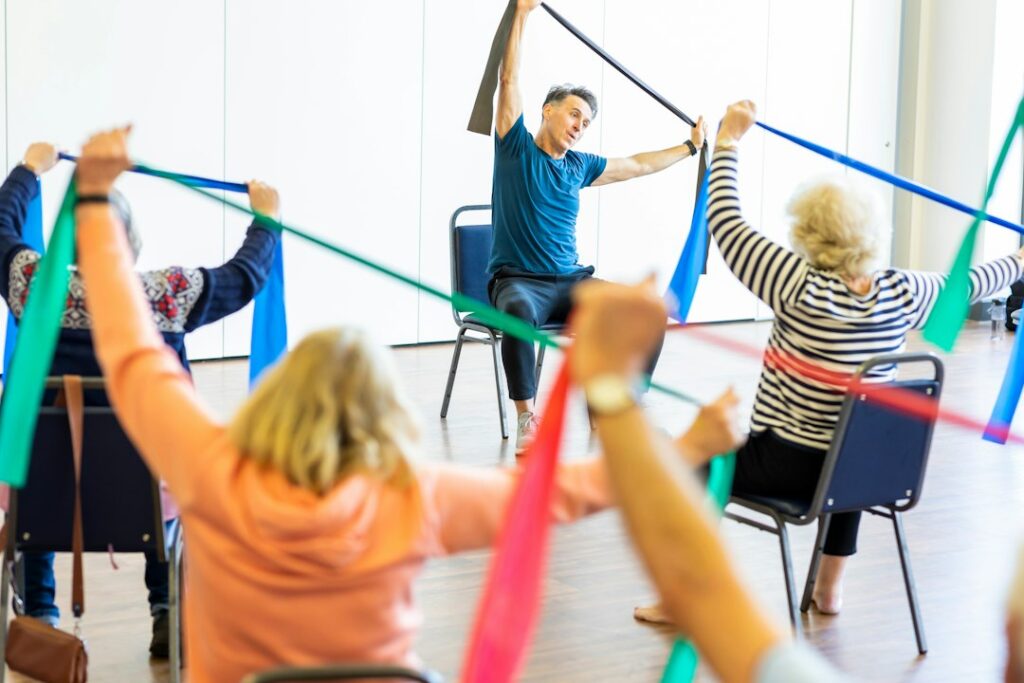
What fitness programs are appropriate for assisted living residents?
Fitness programs in assisted living should help residents maintain strength, balance, flexibility, endurance, and confidence without creating unnecessary risk. The most useful programs are adaptable, consistent, and designed around each person’s health, mobility, interests, and energy level.
Exercise does not need to be strenuous to be beneficial. A program may include seated movements, short walks, stretching, light resistance exercises, balance practice, or recreational activities. Some residents may participate independently, while others may need reminders, supervision, or hands-on assistance.
A well-rounded routine usually includes four types of movement:
- Strength exercises: Standing from a chair, lifting light hand weights, using resistance bands, or performing leg and arm movements can support everyday tasks.
- Balance exercises: Supported heel-to-toe walking, weight shifting, or standing near a stable surface may help reduce fall risk.
- Flexibility exercises: Gentle stretching can support comfortable movement in the shoulders, hips, ankles, neck, and back.
- Endurance activities: Walking, seated marching, low-impact dancing, or short group movement sessions can support heart and lung function.
The right program is not defined by speed or intensity. It is defined by whether residents can participate safely and regularly.
Can older adults exercise while seated?
Yes. Seated exercise can be a practical starting point for people who use wheelchairs, have limited standing tolerance, feel unsteady, or are recovering from illness.
A seated routine might include:
- Raising one knee at a time
- Tapping the feet or moving the ankles
- Reaching forward and overhead within a comfortable range
- Turning the head gently from side to side
- Squeezing and releasing a soft ball
- Moving the arms in controlled circles
- Straightening one knee at a time
- Practicing upright posture and controlled breathing
Chair-based exercise should still be purposeful rather than rushed. Feet should be supported when possible, the chair should be stable, and movements should remain within a comfortable range. Seated exercise is not “less real” exercise; for some residents, it provides the safest way to work on strength, coordination, circulation, and flexibility.
How often should residents exercise?
Many older adults benefit from movement spread across most days of the week, but the exact schedule should match individual ability and medical guidance. Short sessions may be more realistic than a single long workout.
For example, a weekly routine could include:
- Gentle stretching most days
- Brief walking or seated endurance activity several times a week
- Strength exercises on two or more nonconsecutive days
- Balance practice several times a week, with support as needed
- Recreational movement, such as dancing or gardening activities, when available
A resident who becomes tired after five minutes may begin with five minutes and gradually add time as tolerated. Rest periods are part of a safe plan, not a sign of failure. Some people may need activity divided into several short sessions throughout the day.
What should residents ask before joining a fitness class?
Residents and families should ask how the program is adjusted for different ability levels. A class is more useful when participants can choose seated or standing options and do not feel pressured to keep up with others.
Helpful questions include:
- Is the instructor trained to work with older adults?
- Can exercises be modified for arthritis, stroke effects, osteoporosis, or limited vision?
- Are walkers, wheelchairs, or other mobility devices accommodated?
- Is there a stable chair or support surface nearby?
- What happens if someone becomes dizzy, short of breath, or fatigued?
- Is the room well lit and free of clutter?
- Can residents stop or rest without embarrassment?
- Are family members informed about changes in ability or participation?
A suitable program should allow residents to progress gradually. It should also respect personal preferences. Some people prefer group classes, while others are more comfortable with individual exercises, hallway walks, music-based movement, or activities connected to daily routines.
What safety concerns should be considered?
Safety begins with knowing the resident’s current abilities and health conditions. A medical condition does not automatically mean exercise is unsafe, but it may affect the type, intensity, or timing of activity.
Extra care may be needed for residents with:
- A history of falls
- Heart or lung disease
- Uncontrolled blood pressure
- Severe arthritis or joint pain
- Osteoporosis
- Balance or vision problems
- Recent surgery, illness, or hospitalization
- Memory impairment or difficulty following instructions

Exercise should stop if a resident experiences chest pain, faintness, unusual shortness of breath, sudden weakness, confusion, or severe pain. New or concerning symptoms require medical attention. Routine soreness may occur after unfamiliar activity, but sharp, persistent, or worsening pain should not be ignored.
Footwear should fit securely, clothing should allow movement, and walking areas should be free from loose rugs, cords, spills, and unnecessary furniture. In colder months, residents may spend more time indoors, making safe hallways, activity rooms, and seated exercises especially useful.
How can fitness programs support fall prevention?
Exercise can improve strength, balance, and confidence, all of which are connected to safer movement. However, exercise alone cannot prevent every fall. Medication effects, low blood pressure, poor vision, unsafe footwear, clutter, dehydration, and illness can also contribute.
Programs that support fall prevention often include:
- Practicing controlled transfers from sitting to standing
- Strengthening the legs and hips
- Improving ankle movement
- Turning and changing direction safely
- Walking at a comfortable pace
- Learning how to use a walker or cane correctly
- Building confidence without encouraging risky challenges
Residents should not be asked to stand unsupported simply to test their balance. Balance exercises should take place near a stable support, with assistance available when needed.
Does exercise help memory and mood?
Regular movement may support mood, alertness, sleep, and social connection. Group exercise can give residents a reason to leave their rooms, interact with neighbors, and maintain familiar routines.
The mental benefits may come from more than physical exertion. Following a sequence of movements, responding to music, remembering game rules, or walking a familiar route can also encourage attention and coordination.
Fitness programs should not be presented as a cure for memory loss or depression. Still, enjoyable activity can be part of a broader plan that includes social engagement, meaningful routines, adequate sleep, nutrition, and appropriate medical care.
What makes a program enjoyable enough to continue?
Residents are more likely to participate when activities feel relevant and manageable. A class can be physically helpful without feeling like a formal workout.
Examples include:
- Music and movement sessions
- Indoor walking groups
- Chair yoga or gentle stretching
- Balloon or scarf games
- Light gardening tasks
- Tai chi-inspired weight shifting
- Simple dance steps
- Seated sports activities
- Exercise paired with conversation or familiar music
In Windber, seasonal weather may affect outdoor walking opportunities, particularly during icy, wet, or very cold conditions. Indoor alternatives help residents stay active without asking them to navigate unsafe outdoor surfaces.
The most successful routine is one that residents understand, can perform safely, and are willing to repeat. Fitness in assisted living is not about reaching an athletic standard. It is about preserving movement, independence, comfort, and participation in everyday life.
